

THE GREAT WILDEBEEST MIGRATION IN AFRICA

The Great Wildebeest Migration is one of the most extraordinary wildlife spectacles in the world. Every year, millions of wildebeests, accompanied by zebras and gazelles, travel across the vast plains of East Africa in search of fresh grass and water. This remarkable migration mainly occurs between Serengeti National Park in Tanzania and Maasai Mara National Reserve in Kenya.
Generally, the Great Wildebeest migration follows seasonal rainfall patterns that determine where green pastures are available. During the early months of the year, large herds remain in the southern Serengeti plains where food is abundant for grazing and calving. However, as the dry season approaches, the animals begin moving northward toward the Maasai Mara. Along the journey, they cross dangerous rivers such as the Mara and Grumeti Rivers, where many animals face threats from strong currents and hungry crocodiles. Therefore, the migration becomes both a survival journey and a breathtaking natural event attracting tourists from across the world.
Appearance
The wildebeest, also known as the “gnu,” is a large antelope belonging to the Bovidae family, which includes cattle, goats and sheep. Moreover, there are two major species of wildebeests: the blue wildebeest and the black wildebeest. Among these, the blue wildebeest is the most common species found within the Serengeti-Maasai Mara ecosystem.
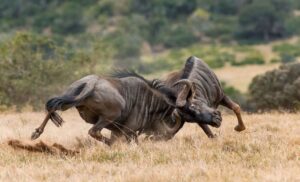
Both male and female wildebeests possess strong curved horns and muscular bodies adapted for long-distance movement. In addition, they have broad shoulders, thin legs and dark gray coats with black stripes along their bodies. As a result, their appearance allows them to survive in open grasslands while traveling across long distances during migration seasons.

Diet
Wildebeests are herbivores that mainly feed on short green grasses found within the savannah plains. Because they require fresh vegetation for survival, they constantly move from one region to another depending on rainfall patterns.
Furthermore, wildebeests usually graze alongside zebras and gazelles, which helps them locate better feeding areas. While zebras consume taller grasses, wildebeests prefer shorter and softer grasses. Consequently, this feeding relationship reduces competition among the different animal species during migration.

Behavior
Wildebeests are highly social animals that live and travel in massive herds for protection and survival. During migration, thousands of animals move together in a clockwise pattern across Tanzania and Kenya.
In addition, they remain alert to predators such as lions, cheetahs, hyenas and crocodiles. Wildebeests also rely on warning signals from other animals, especially zebras and baboons, to detect danger. However, despite their large numbers, many wildebeests still fall prey to predators or die while crossing rivers. Therefore, survival during migration depends greatly on strength, speed and group movement.
Breeding
Breeding among wildebeests usually occurs at the end of the rainy season when food is readily available. After a short gestation period, thousands of calves are born within a few weeks, especially in the southern Serengeti plains.
Interestingly, newborn calves can stand and run only a few minutes after birth. This ability is extremely important because it allows them to move with the migrating herd and escape predators quickly. Nevertheless, some calves still become targets for predators such as hyenas and lions.

Habitat
Wildebeests mainly inhabit grasslands, open woodlands and savannah ecosystems across eastern and southern Africa. Their largest populations are found within the Serengeti ecosystem in Tanzania and the Maasai Mara Reserve in Kenya.
Moreover, these habitats provide enough grass, water, and open space necessary for migration and survival. Because of favorable environmental conditions, the Serengeti-Maasai Mara ecosystem supports one of the largest wildlife movements on Earth. Therefore, protecting these habitats remains essential for preserving the Great Wildebeest Migration for future generations.

Conclusion
In conclusion, the Great Wildebeest Migration remains one of Africa’s greatest natural wonders. The movement of millions of wildebeests across dangerous landscapes demonstrates the struggle for survival and the beauty of wildlife in its natural environment.
Therefore, the migration not only supports biodiversity and tourism but also reminds people about the importance of wildlife conservation and environmental protection.